What's Next for Fleets? A Report from the RHA Future Forum
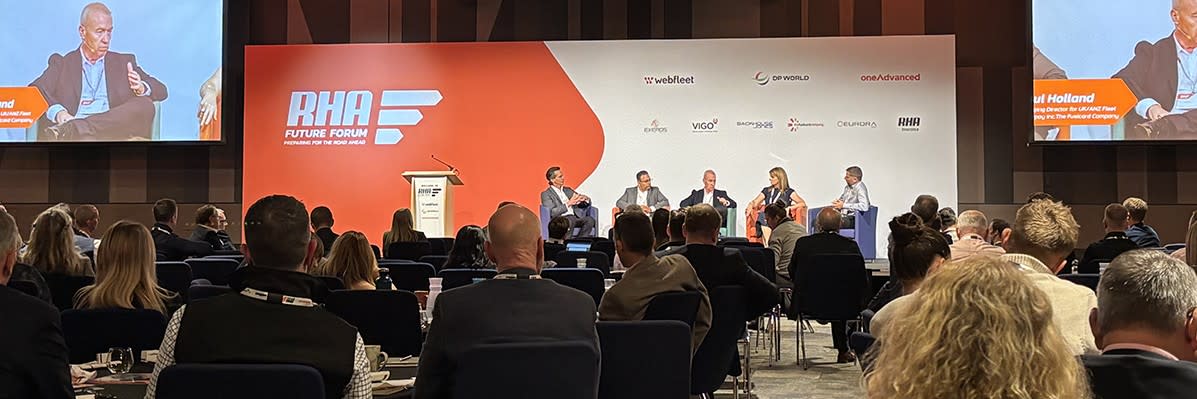


The logistics and haulage sectors are grappling with a significant challenge: making their operations more sustainable. More than just an environmental issue, this is a complex problem with economic, operational and policy factors.
To address these issues, the RHA recently met with a group of industry leaders. The forum's goal was to discuss these challenges and explore how technology, including fuel cards, can provide solutions. Our own MD for UK/ANZ Fleet, Paul Holland, Corpay, including UK brand The Fuelcard Company, was invited to join the technology panel, and the key takeaways were clear: the industry needs to foster a collaborative spirit, shift its collective mindset, and advocate for policies that support all types of technology.
The Decarbonisation Challenge
The scale of the necessary change in road transport is immense. While exact figures vary, logistics and transport are major contributors to global emissions. A recent survey conducted by the RHA revealed that 70% of HGV operators lack a formal decarbonisation plan. However, a more optimistic note was sounded at the event, where half of the 452 attendees reported being on their way to a "net zero" goal, with many starting with their fleets.
Not everyone agrees on the best approach. Geoff Potter, Managing Director of Gray and Adams, argued that battery vehicles are not the only solution. He critiqued current legislation for its narrow focus on "tailpipe emissions," pointing out that heavier battery vehicles could increase non-exhaust emissions from tyres and brakes. He also suggested that internal combustion engine vehicles (ICEVs) using biofuels may produce less overall CO2. Potter called for a policy reset that focuses on decarbonisation more broadly, rather than just one type of vehicle.
Operational realities also create hurdles. Ben Foulser, a Partner at KPMG, highlighted the central conflict of cost versus revenue. While electric cars and vans offer clear cost savings, the same isn't true for commercial vehicles. Electric trucks, for instance, have higher upfront costs, creating a major financial barrier. Other challenges include limited range, reduced performance in cold weather, and long charging times. The lack of charging infrastructure is another significant obstacle, prompting many operators to plan for depot-based charging as for many in haulage this would be the most suitable way to charge.
Despite these challenges, there's strong motivation for change. Customer demand is a major driver, with a survey of the room indicating that over 50% of the 452 attendees cite it as a key reason to move forward. End consumers, especially younger generations, are increasingly willing to pay more for sustainable choices, which is making decarbonisation a financially viable strategy for businesses.
Innovative Solutions and Technology
Some companies are already taking action. DP World, for example, has a Low Carbon Truck Programme that gives frequent port visitors incentives like biofuel at the same price as diesel. Their Modal Shift Programme has moved over 125,000 truck trips to rail, saving more than 10 million truck miles.
Technology is also a critical tool for improving efficiency. Helen Flanagan, Product Director at Wincanton, stressed the importance of using data and AI to optimise routes, reduce empty miles, and increase vehicle fill rates. AI can also help with predictive maintenance, cost savings, and automating tasks like invoicing.
Payment technology, such as the use of a fuel card, plays a vital role. Paul Holland, Managing Director of UK/ANZ Fleet at Corpay, explained that fuel cards can help solve the "chicken and egg" problem of EV rollout. They give fleets a way to pay for different types of fuel and monitor their use. They also allow fleet managers to make informed decisions about where and when to charge or refuel. Importantly, fuel cards and fleet fuel card programmes capture data that can be used to inform efficiency strategies, measure fuel card savings, and develop driver incentives.
A Path Forward
Throughout the discussions, a clear message emerged: collaboration is essential.
Industry leaders agreed that working together is the best way to move forward. The future will likely involve blended fleets, with different types of fuel and technology, making a "technology-neutral" policy approach crucial.
Ultimately, while technology is an enabler, people are the most important part of the equation. As the industry moves forward, the focus must be on training and empowering staff to adapt to these new systems. Decarbonising road transport is a complex, long-term project. While there are significant obstacles, customer demand, technology, and industry-wide collaboration are paving the way for a more sustainable future. Fleet managers who embrace future technology and versatile fuel cards will be best positioned for success.
“The future of fleets isn't about one single solution. It's about an array of different fuel types, from electric to alternative fuels, all working together. The road ahead will be powered by a diverse network of fuelling options.”
Paul Holland, Managing Director, UK/ANZ Fleet at Corpay, including UK brand, The Fuelcard Company